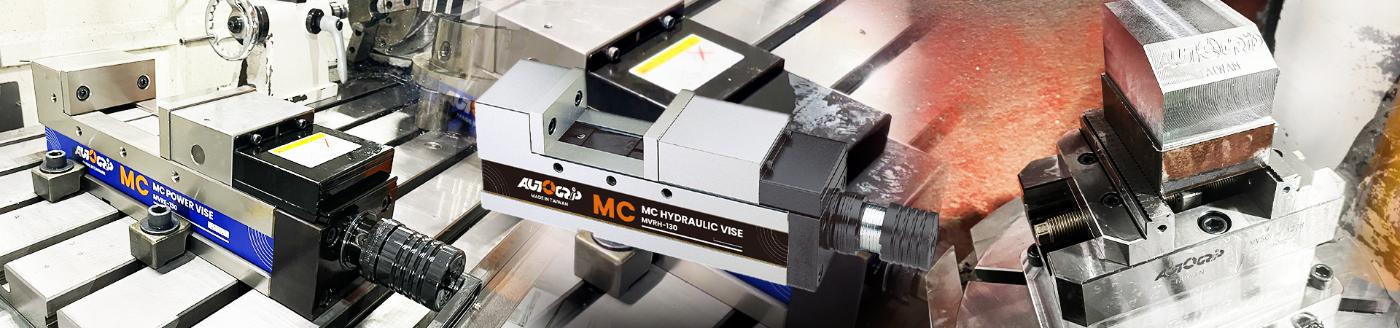
Choosing the right CNC machine vise is essential for machining accuracy, workpiece stability, and production efficiency. The ideal vise depends on several factors, including machine configuration, workpiece dimensions, clamping requirements, and machining conditions.
AUTOGRIP offers three precision vise series designed for different machining applications: MVSC 5-Axis Self-Centering Vise, MVRH MC Hydraulic Vise, and MVRE MC Power Vise.
This guide compares their clamping mechanisms, key features, and recommended applications to help manufacturers and engineers identify the right workholding solution for their machining requirements.
MVSC vs. MVRH vs. MVRE: What Are the Main Differences?
The primary difference between the three series is how they position and clamp the workpiece.
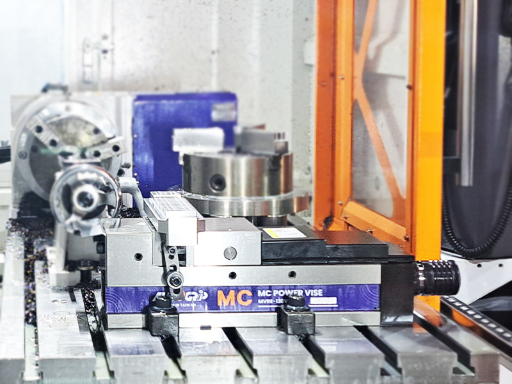
Note: Specifications are based on AUTOGRIP's published product information. Centering repeatability and clamping force are different performance measures. Final selection requires checking the individual model and its operating conditions.
MVSC focuses on self-centering and tool accessibility for multi-axis machining. MVRH uses hydraulic-assisted manual clamping, while MVRE relies on a mechanical power-boost mechanism for CNC milling applications.
| Selection Factor |
MVSC | MVRH | MVRE |
| Product Type |
5-Axis Self-Centering Vise | MC Hydraulic Vise | MC Power Vise |
| Clamping Mechanism | Synchronized self-centering jaws | Manual screw with integrated hydraulic assistance | Mechanical two-stage power boost |
| Main Machine Applications | 4-axis and 5-axis machining; compatible horizontal and vertical setups | Horizontal machining centers and other compatible machining centers |
CNC milling machines and machining centers |
| Primary Selection Priority | Centering repeatability and tool accessibility | Stable hydraulic-assisted clamping | Mechanically boosted clamping and workpiece stability |
| Published Performance Reference |
Centering repeatability: ±0.01 mm | Clamping force: 4,000–6,900 kgf, depending on model | Clamping force: 3,000–4,500 kgf, depending on model |
1. MVSC: 5-Axis Self-Centering Vise for Multi-Axis Machining
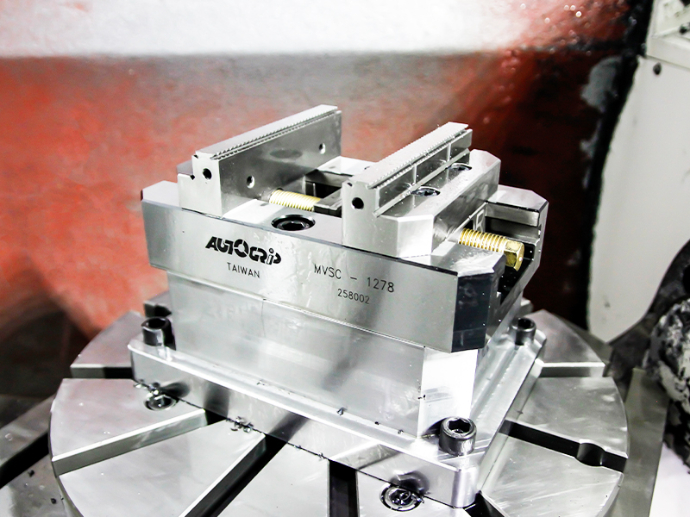
The AUTOGRIP MVSC 5-Axis Self-Centering Vise is designed for machining applications that require accurate workpiece positioning and access to multiple machining surfaces.
Its synchronized jaw mechanism moves both jaws toward the center, helping maintain consistent workpiece positioning. With a specified centering repeatability of ±0.01 mm, MVSC supports precision machining and repeatable setup conditions.
Its compact structure also helps improve tool accessibility and reduce interference during multi-axis machining.
Key Features
- Synchronized self-centering jaw mechanism
- Centering repeatability of ±0.01 mm
- Compact design for improved tool accessibility
- Suitable for 4-axis and 5-axis machining applications
Recommended Applications
- 4-axis and 5-axis CNC machining.
- Multi-face machining of complex components.
- Precision workpieces requiring repeatable centering.
- Applications involving rotary tables and multi-axis fixtures.
2. MVRH: MC Hydraulic Vise for Stable, High-Force Clamping
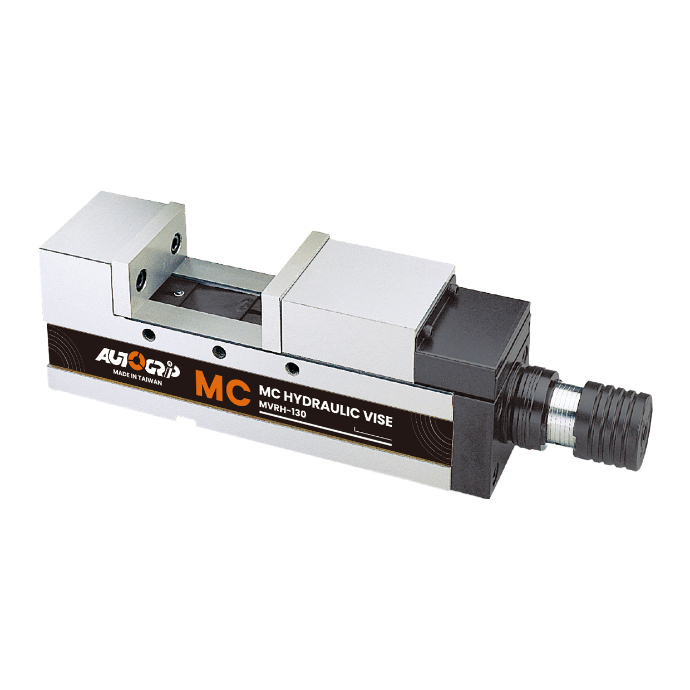
The AUTOGRIP MVRH MC Hydraulic Vise combines manual screw operation with integrated hydraulic assistance to deliver substantial and stable clamping force.
Its down-thrust spherical-segment mechanism helps keep the workpiece seated against its supporting surface during clamping, reducing the risk of jaw lifting and workpiece tilting.
Constructed with rigid ductile iron and hardened sliding surfaces, MVRH is designed to support demanding and repetitive machining operations.
Key Features
- Manual screw operation with hydraulic assistance
- High clamping force for demanding machining applications
- Down-thrust mechanism to improve workpiece seating
- Rigid construction with hardened sliding surfaces
Recommended Applications
- CNC horizontal machining centers
- Compatible vertical and horizontal machining setups
- Repetitive machining requiring stable clamping
- Applications requiring hydraulic-assisted manual operation
The MVRH series includes models from MVRH-100 to MVRH-200. Selection should be based on required jaw opening, workpiece dimensions, clamping force, and installation space.
3. MVRE: MC Power Vise for CNC Milling Applications
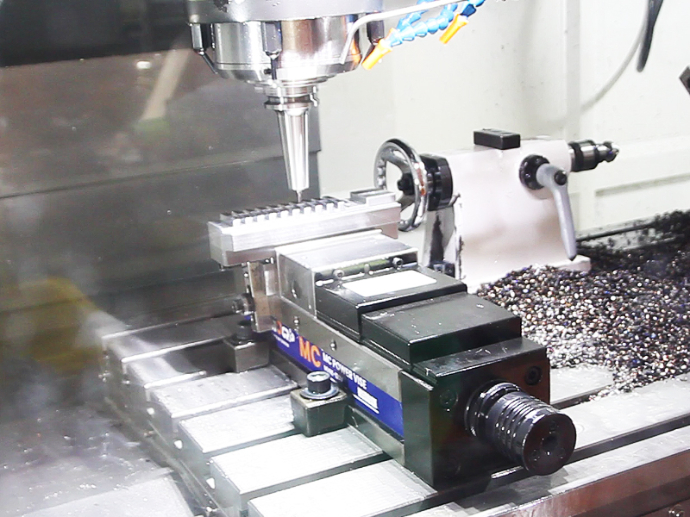
The AUTOGRIP MVRE MC Power Vise is engineered for CNC milling machines and machining centers that require rigid and reliable workholding.
Unlike MVRH, which uses hydraulic assistance, MVRE features a mechanical two-stage power-boost mechanism that generates increased clamping force through manual operation.
Its down-thrust spherical-segment mechanism helps prevent workpiece lifting during clamping, while its rigid construction and hardened sliding surfaces support consistent performance in repetitive milling operations.
Key Features
- Mechanical two-stage power-boost mechanism
- High clamping force through manual operation
- Down-thrust mechanism for stable workpiece seating
- Rigid structure for demanding milling applications
Recommended Applications
- CNC milling and machining centers
- Heavy-cutting operations requiring rigid workholding
- Repetitive manual clamping in production
- Applications where mechanical power boosting is preferred
The MVRE series includes models from MVRE-100 to MVRE-200, with different vise dimensions, jaw openings, and clamping-force ratings.
For thin-walled or easily deformed workpieces, clamping force should be carefully evaluated to avoid excessive deformation and maintain machining accuracy.
How to Choose the Right CNC Machine Vise
Before selecting a vise, evaluate your machining requirements based on the following five factors.
- 4-axis or 5-axis machining: Consider MVSC for self-centering and multi-face machining accessibility.
- Horizontal machining centers: Evaluate MVRH for hydraulic-assisted manual clamping.
- CNC milling machines and machining centers: Consider MVRE when mechanical power boosting is preferred.
- Always verify mounting dimensions, machine travel, available workspace, and fixture compatibility.
Each series offers a different clamping approach:
MVSC: Synchronized jaws for self-centering workpiece positioning.
MVRH: Manual screw operation with integrated hydraulic assistance.
MVRE: Mechanical two-stage power boosting.
Consider the required clamping force, operator workflow, cutting conditions, and workpiece characteristics when evaluating the mechanism.
Both MVRH and MVRE incorporate down-thrust mechanisms. Therefore, the primary difference between these two series is their clamping mechanism rather than down-thrust functionality.
Check the workpiece width, height, and length, along with the required jaw-opening range.
The vise must securely accommodate the workpiece without obstructing tool movement or exceeding the machine's available workspace.
AUTOGRIP provides dimensional specifications and 2D/3D drawing resources to help engineers verify installation and fixture requirements before ordering.
Higher cutting loads may require greater clamping force. However, excessive clamping pressure can deform thin-walled or delicate components.
The appropriate clamping force depends on:
Workpiece material and geometry
Cutting forces and machining conditions
Jaw contact area
Workpiece support and fixture design
The objective is to achieve reliable workholding while maintaining the required machining accuracy.
To help AUTOGRIP identify a suitable model, prepare the following information:
CNC machine type and model
Workpiece material and dimensions
Machining operations and cutting conditions
Required jaw opening and positioning method
Available mounting space and fixture requirements
Providing these details enables more accurate model recommendations and engineering evaluation.
FAQ : Green Transformation in the Machining Chuck Industry
The MVSC 5-Axis Self-Centering Vise is designed for 4-axis and 5-axis machining applications that require accurate centering and improved tool accessibility. Final compatibility depends on rotary table dimensions, mounting arrangements, and workpiece requirements.
MVRH uses a manually operated screw with integrated hydraulic assistance, while MVRE features a mechanical two-stage power-boost mechanism. Both are designed for stable workholding in machining applications, but their clamping mechanisms and specifications differ.
Not necessarily. The appropriate vise depends on the required clamping force, workpiece rigidity, cutting conditions, and fixture design. Both hydraulic-assisted and mechanically boosted vises can provide effective workholding when properly selected.
Potentially, but compatibility depends on more than machine orientation. Mounting dimensions, table capacity, machining clearance, and workpiece accessibility must also be evaluated.
Start with your machine type, workpiece dimensions, required clamping force, and machining conditions. AUTOGRIP can assist in evaluating the appropriate vise series and model based on your application requirements.
Find the Right AUTOGRIP Vise for Your Application
Choosing the right CNC machine vise means matching its clamping mechanism, specifications, and configuration to your machining process.
MVSC: For self-centering precision and multi-axis machining accessibility.
MVRH: For hydraulic-assisted manual clamping and stable workholding.
MVRE: For mechanically boosted clamping in CNC milling applications.
Not sure which model best fits your machine or workpiece?
Contact AUTOGRIP for technical assistance and vise selection. Share your machine specifications, workpiece dimensions, and machining requirements with our team to find the right workholding solution.